
When a bigger team starts looking at us seriously, the first real meeting is almost never about dashboards. Someone from data, security or the AI team joins, and the questions get specific fast. Where does the data land? Who can see it? Does the number in the report match the number in the warehouse? Can an agent query it without making things up?
Fair questions. Customer feedback is the messiest data most companies own, and it only becomes useful when it sits next to product and business data, inside the systems the team already runs. These are the seven questions we hear most, and how we answer each one.
At a glance
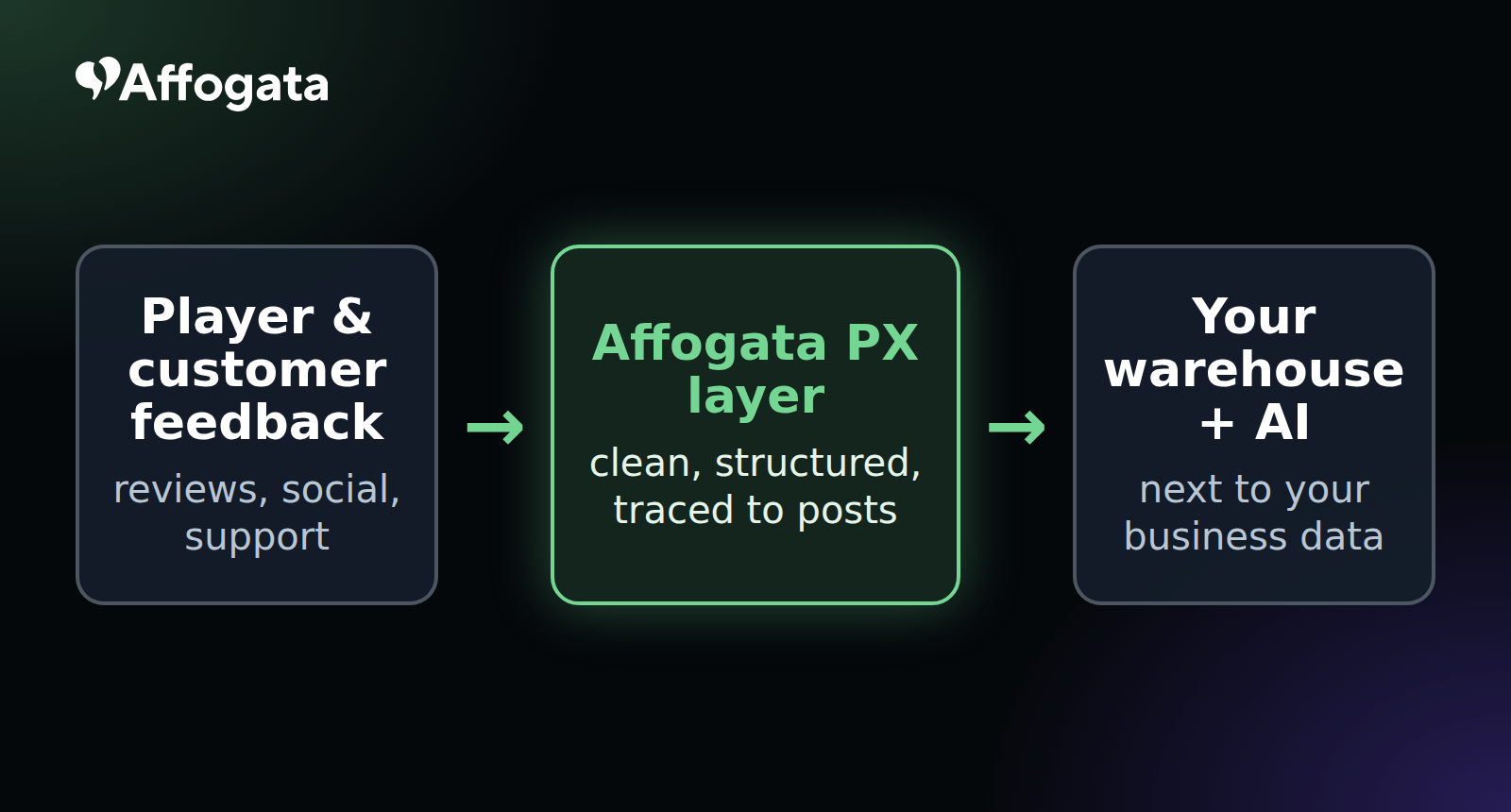
- Where does the data end up? In your tools: the Affogata UI, your warehouse, your AI assistant or the API.
- Is the noise gone before anything gets counted? Spam, bots, duplicates and marketing posts come out first.
- Does one number mean the same thing everywhere? One definition, the same score in every surface.
- Can we open the evidence behind every number? Every insight links to the real posts behind it.
- Who can see what, and does it train AI? Read-only, governed access, never used to train AI.
- Can AI agents query it safely? Yes, over MCP, answering from your live data.
- Who keeps it working after go-live? Our engineers, together with yours.
1. Where does the data end up?
Wherever your team already works. It's the same data with four ways in:
- UI for CX, community and product people who want to explore, filter and read the actual posts.
- DIL (our Data Integration Layer) for data teams. Live Iceberg or Delta Lake tables in Snowflake, Databricks or BigQuery, in a stable schema. Model it in dbt, join it to revenue and retention, chart it in the BI tool you already have.
- MCP for AI. Claude, ChatGPT or Gemini answer from your live feedback data in plain language.
- API for builders who want it inside their own apps and workflows.
The point is that feedback stops being a separate tool someone has to remember to open. It becomes a table and an endpoint, like the rest of your stack.
2. Is the noise gone before anything gets counted?
This is the part people underestimate. Public feedback is full of things that aren't feedback: bots, spam, copy-paste duplicates, giveaways, brand marketing, reposts. If you count them, every chart after that is wrong in a way nobody can see. I wrote about signal over noise on its own.
So the order matters. We clean first, then deduplicate, redact PII, score sentiment and group posts into clusters by meaning, not by keyword. Only after that does anything get counted. Real insights from noisy data, in that order. Here are the seven kinds of noise we take out first.
Slang, sarcasm, memes, coordinated review bombs and launch-day spikes are the hardest test. A system that holds up there holds up for a bank or a retailer.
3. Does one number mean the same thing everywhere?
This is the engineering problem we spend the most time on, and the one enterprise data teams ask about first. If sentiment is calculated one way in the dashboard, another way in the export and a third way when an AI assistant improvises it, people stop trusting all three. More on that in the insights foundation for what you build next.
Our answer is one definition, computed once, served everywhere. Take the Affogata Impact Score from our public benchmark: a 0 to 10 score of how customers feel, where higher is happier and 5 is mixed. The same score shows up in the UI, in the warehouse tables and in what an agent gets back over MCP.
A consistent definition is also what makes comparisons worth anything. In week 40 of the benchmark (September 28 to October 4, 2026):
- A neobank had 8,923 posts and scored 9.5.
- A payments app had 1,465 posts and scored 2.6.
- A music streaming app had 17,450 posts and scored 6.2.
- A video streaming service had 903 posts and scored 1.2.

Two money apps, almost seven points apart, on very different volumes. Volume tells you how loud people are. The score tells you how they feel. You only get to put those side by side, across nearly 80 consumer brands, if the definition never changes under you.
4. Can we open the evidence behind every number?
Yes, and this is the one we care about most. Every number and every insight links back to the real posts behind it. Nothing is a black box. If a VP asks "says who?", the answer is one click away.
The chain we build every insight on:
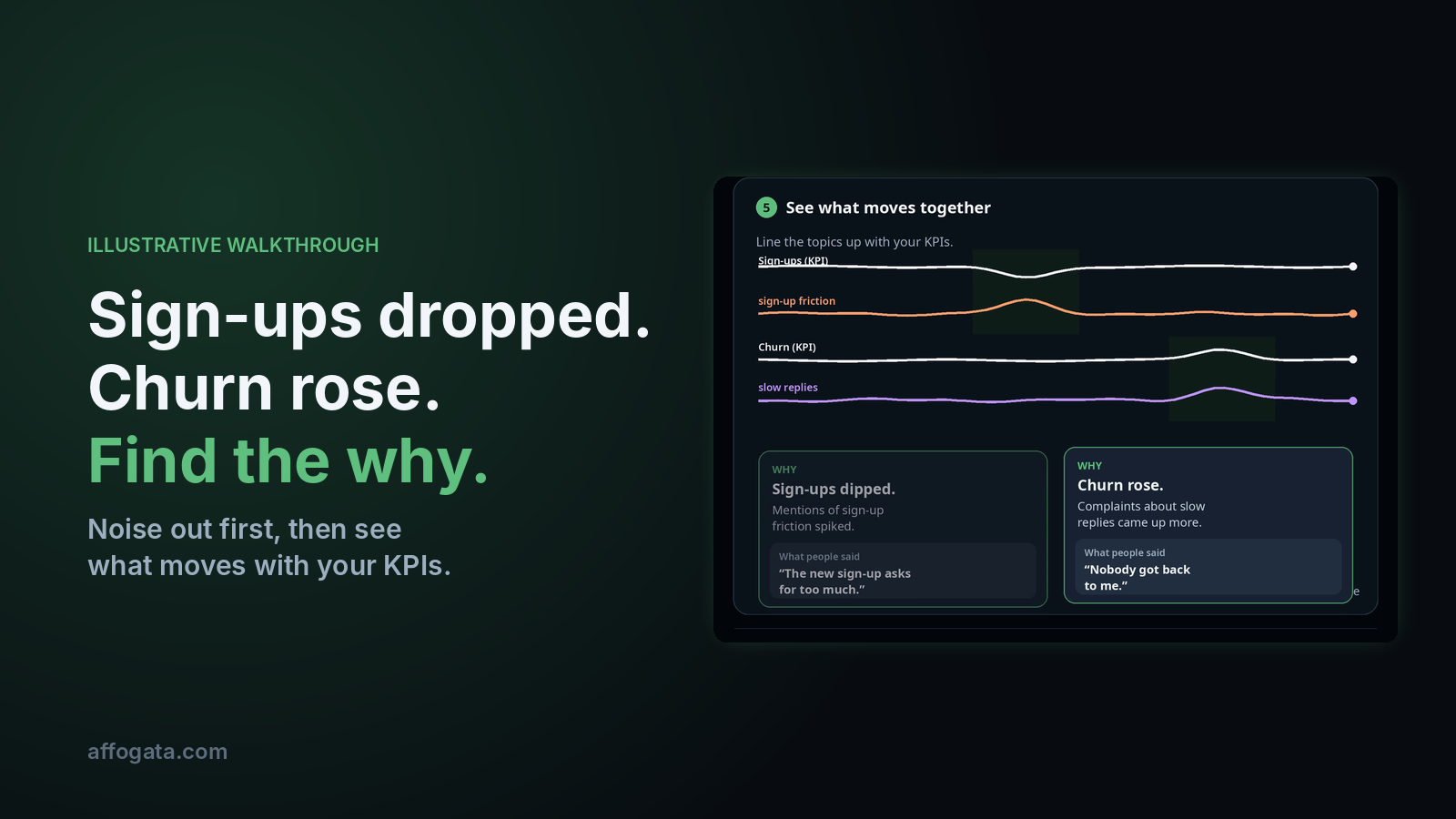
- Insight: what moved, for example a score dropping or a cluster growing.
- Proof: the actual posts behind it, readable, not summarized away.
- Cause: what event or release it lines up with, shown on one timeline.
- Impact: how big it is, how negative it is and who it touches, so the team knows what to fix first.
We say correlate, on purpose. The data shows what lines up with what. Your team, which knows the product, makes the call. Here’s a one-minute walkthrough of the whole chain, from noise to a KPI.
5. Who can see what, and does it train AI?
Security reviews usually land on the same handful of things, so here they are plainly:
- Access is read-only and governed.
- Your data is never used to train AI models.
- PII is redacted in processing, and one compliance model covers every way in.
- We work under GDPR and CCPA, and hold ISO 27001, 27701 and 42001.
None of that is exciting. It's the boring part that decides whether a project ships or sits in procurement for six months.
6. Can AI agents query it safely?
We hear this one in almost every meeting now. Teams are building internal agents, and an agent is only as good as the data under it. Point one at raw, noisy feedback and you get a confident answer built on bots and duplicates.
Over MCP (Model Context Protocol, the open standard AI assistants use to call tools), an agent queries the cleaned, clustered, scored data, with the same definitions as everywhere else and the posts behind each answer. It's read-only, so the agent can look but can't change anything. You can try it yourself on public data in the free MCP sandbox, no sales call needed.
7. Who keeps it working after go-live?
Our engineers, side by side with yours. With larger teams we work more like an internal dev team than a vendor: we design the schema around your questions, build the integrations into your warehouse and tools, adapt the clusters and topics to your product, and keep all of it running as your product and your questions change.
That's also our answer to "can't we just build this ourselves with AI?". You can build a prototype in a week. Keeping noise removal, definitions, evidence links, governance and integrations working every day, across every source, is the actual job. Most teams would rather spend their engineers on what they build on top.
FAQ
Is Affogata only for gaming companies?
No. Gaming is where we started, not the boundary. We work with any unstructured data, from 40+ sources plus your own, across consumer apps, fintech, commerce, media and more. Here’s one week across seven industries.
Can we get the data into our own warehouse?
Yes. The Data Integration Layer delivers live tables into Snowflake, Databricks or BigQuery in a stable schema, ready to join with your product and revenue data.
Can Affogata tie feedback to churn or revenue?
Yes, by correlation. Once feedback sits next to your product and business data, your team can see which themes line up with churn, conversion or revenue moves, with the posts behind each one.
Is our data used to train AI?
No. Your data is never used to train AI models, and access is read-only.
How do we try it without a long sales process?
Start with the free MCP sandbox on public data. If it's useful, meet the team and we'll look at your own data together.
See it on real data
The quickest way to judge all of this is to ask the data a question yourself. Open the free MCP sandbox and connect your AI assistant in a few minutes. Or, if you're already thinking about your own stack, meet Affogata and bring your hardest question.