

Last updated: October 9, 2026
Ambitious technology teams build around data they can trust. Customer and player experience should be no different.
Working with leading brands in gaming and fintech has sharpened our view of what that means. The conversation is moving beyond reports and dashboards toward a more demanding question:
Can we use this signal inside our own systems, alongside the rest of our business data, to make better decisions and build better products?
At Affogata, that is the job we build for. Dependable PX data infrastructure, backed by an engineering team that works alongside yours.
One foundation. Multiple ways to build on it.
The shift is away from asking everyone to open another dashboard. Teams want feedback available where they already work: their warehouse, product tools, sales and support systems, and AI assistants.
A dashboard still has a role. It should not define the limits of the platform.
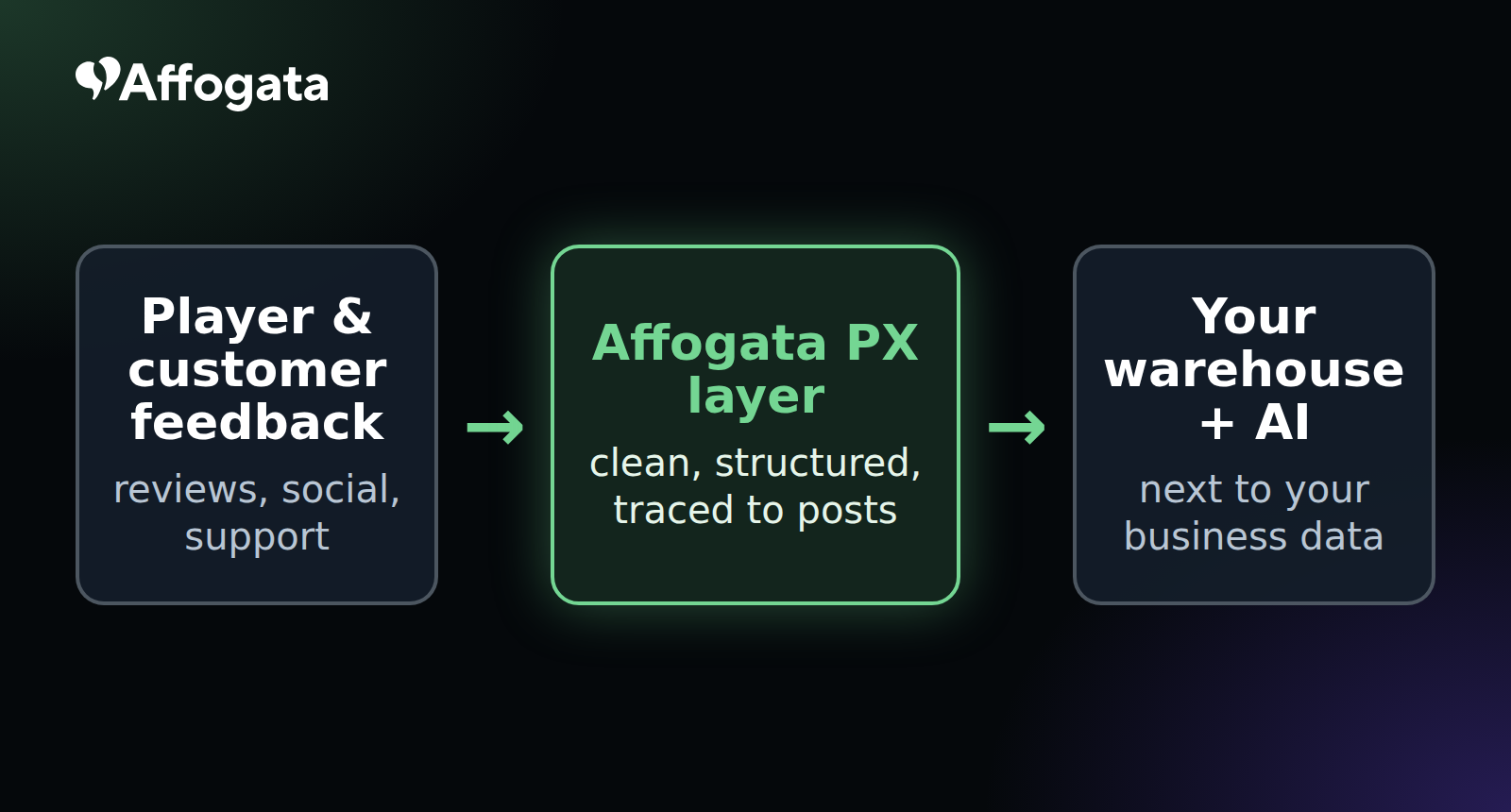
- Warehouse integration brings structured PX data into the company’s data stack.
- APIs connect it to internal tools and workflows.
- MCP, the Model Context Protocol, lets AI assistants query that signal without someone exporting a file and pasting a sample into a prompt.
The technical requirement is simple to state and harder to deliver: the same entities, definitions and numbers, whichever route the team uses. For the same scope, filters and time period, an analyst querying the warehouse and an AI answering a product question should not be working from different versions of customer experience.
That is how we approach the Affogata PX platform. Give teams a consistent data foundation, then let them build the interfaces and workflows that fit their business.
Definitions break before pipelines do
One lesson keeps coming back. Getting the data flowing is only the beginning. Keeping its meaning consistent as products, markets and questions change takes ongoing engineering.
A topic like “login issues” gets renamed, split or merged as a product evolves. New markets add languages. A big release brings vocabulary that did not exist last month. If the warehouse, the dashboard and the AI each keep their own version of those definitions, the numbers drift apart, and the team ends up arguing about whose number is right instead of what to fix.
So we treat the definitions as part of the data model, shared by every route into it. That is where our engineers spend real time with customer teams: agreeing which sources matter for their questions, shaping topics and entities around their products, and fitting delivery into their stack, whether that is tables in their warehouse, an API feed or their AI assistants. Then we keep it running and adjust it as releases, markets and questions change.
Before the answer, get the signal right
The first question is not which model to use. It is what the model will be reading.
Public data contains real customer discussions alongside spam, duplicates, promotional content and bots. Feeding all of it into AI does not make the picture more complete. It can make the noise more convincing.
And it is noisy by design. Social platforms make money on attention, so feeds reward what spreads, not what is true: outrage, engagement bait, ads, coordinated spikes, and a growing share of AI-generated posts. The noisier the raw data gets, the more it is worth knowing what is real.
So cleaning comes first: bots, duplicates, ads, AI filler and engagement bait out, with new patterns added as they show up. Then a test of what is left: does it hold up across channels, across different authors and over time? A theme that appears in one burst from a handful of accounts is not the same as one that keeps coming back across communities, reviews and support. Only then does it make sense to group discussions by meaning and context, rather than treating every repeated phrase as another customer problem.
Affogata’s Conversation Clusters help turn that material into structured themes teams can investigate. The useful output is not a longer summary. It is a clearer view of the real discussion:
- What are customers and players trying to do?
- Where are they getting stuck?
- What changed after a release?
- Which problems should we investigate or improve next?
Every answer should come with its evidence
Teams should be able to inspect the discussion behind an answer, not accept it because the wording sounds confident.
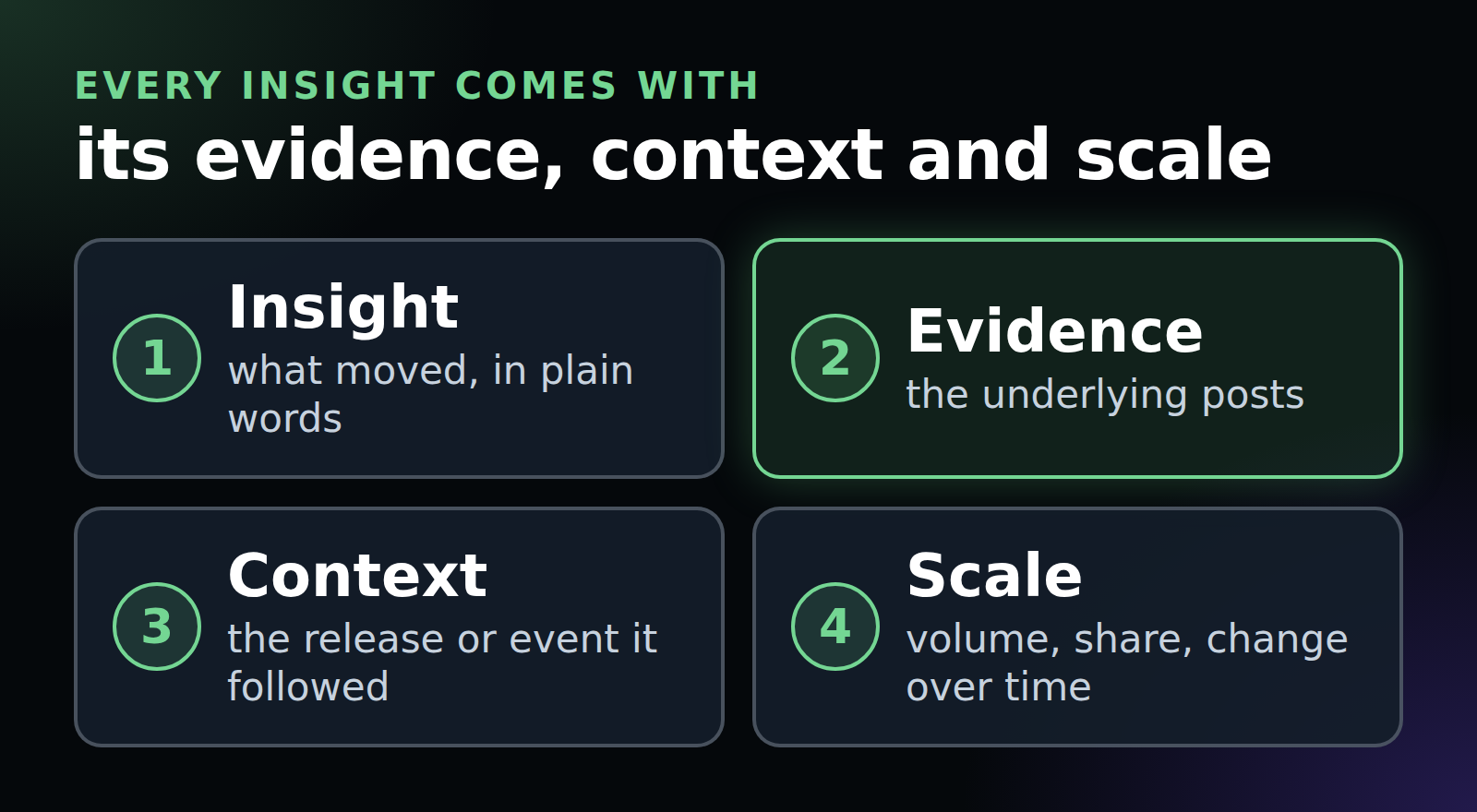
An insight should show the posts behind it, the release or event associated with the change, and the size of the change within a defined period. That gives teams evidence to investigate, without treating an association as proof of causality.
A line like “login complaints are up this week” is a starting point. The same line with the exact posts, the release it followed and its share of negative volume over the week is something a team can investigate, act on and defend in the room.
What a dependable foundation lets you build
As AI and product capabilities get more sophisticated, the quality of the feedback underneath them matters more, not less. A model is only as good as what it reads. A workflow is only as good as the numbers it trusts.
With a consistent, traceable PX layer in place, teams stop rebuilding the basics and start building on top: release reviews that start from evidence, AI agents that answer from clean signal, and product, support and revenue data finally read side by side.
That is the foundation we build with our customers, and the one we think the next era of customer and player experience analytics runs on.
What are you seeing in your organization? Is customer and player feedback still a report people open, or is it becoming data your teams can build with?
Talk through your stack with our engineers
Bring a product question and your data setup. We will show how customer and player feedback can fit your warehouse, tools and AI.