Published October 16, 2026
In my last post I wrote about signal over noise: the why sits in a small fraction of what people say. So the next question is: noise, meaning what, exactly?
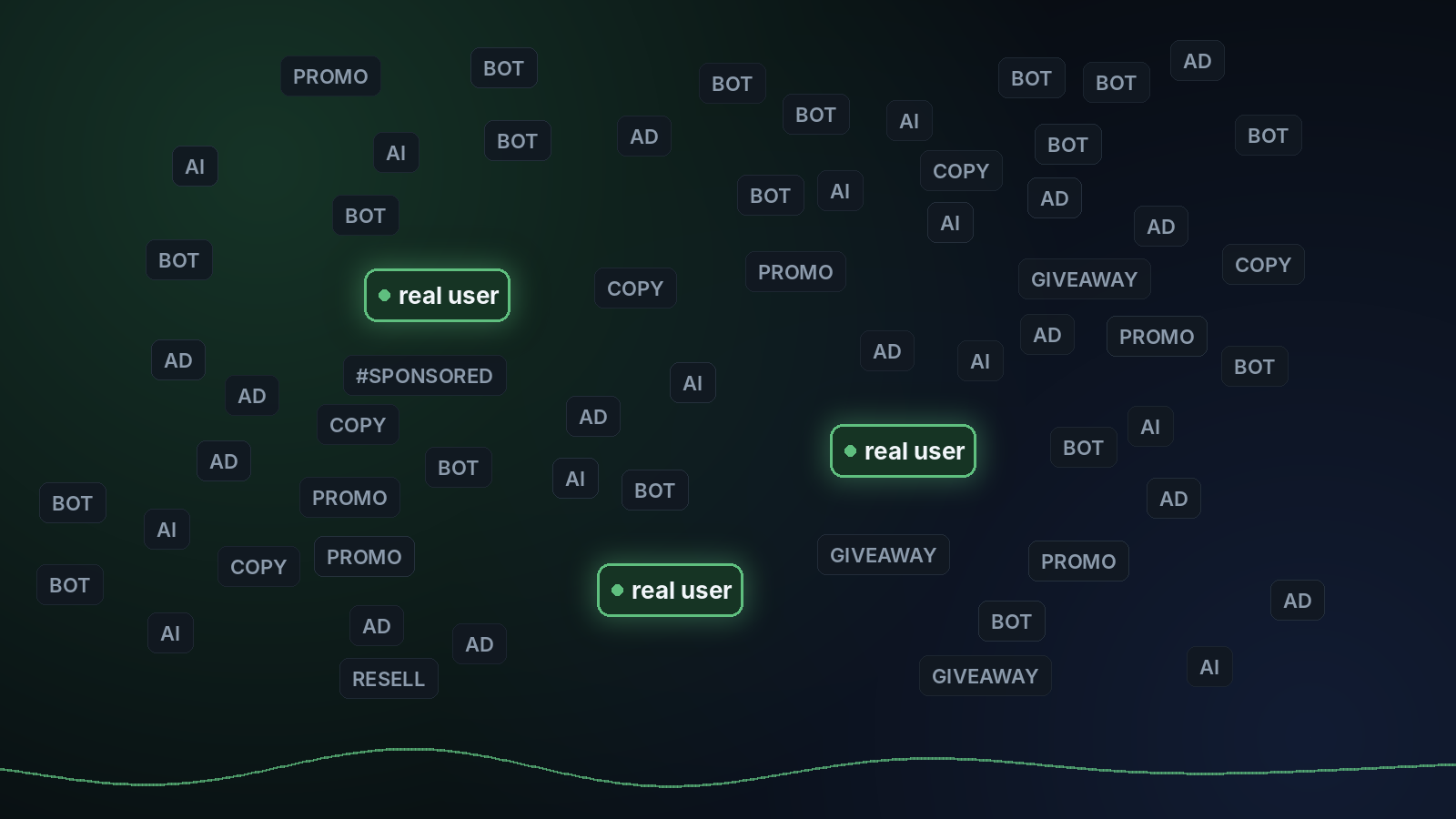
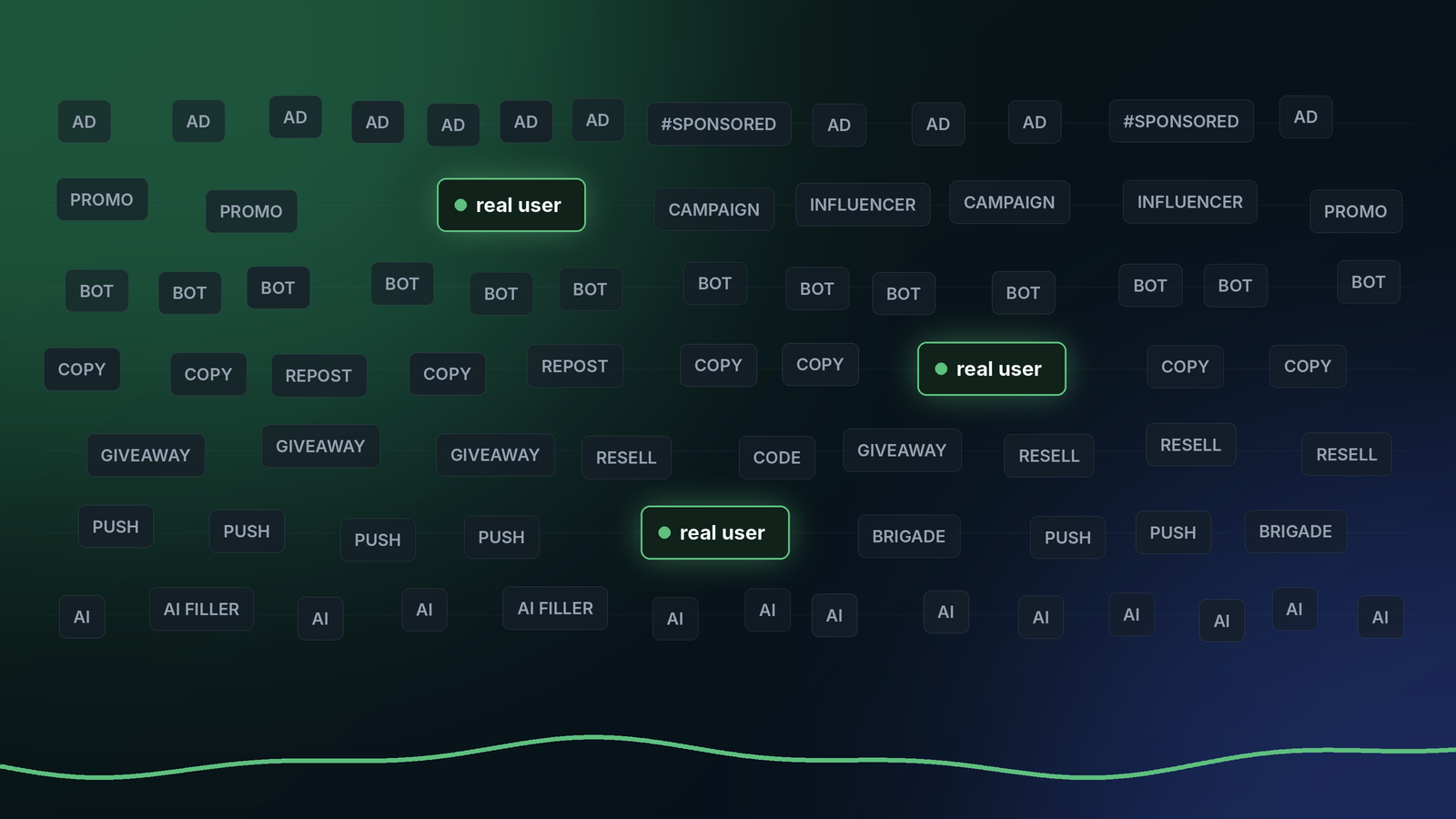
“Noise” sounds like one thing. It isn’t. We see the same seven kinds every day, around games, trading apps, streaming platforms, consumer brands and public figures. Each bends a report in its own way, and none of them is your customers telling you what they think.
At a glance
- What counts as noise: anything that isn’t a real customer
- The 7 kinds: ads, campaigns, bots, copies, giveaways, coordinated pushes, AI filler
- A noisy two weeks: the chart
- Why keyword rules don’t hold: noise changes faster than rules
- How Affogata keeps it out: filter before counting, keep the proof
- Every industry has its own mix
- FAQ
What counts as noise in customer feedback data?
Noise is any piece of content that isn’t a real customer speaking for themselves. It can be real content and still be noise, because it was paid for, copied, automated or organized to look bigger than it is.
The test I use: is this one person telling me about their own experience with the product?
What are the 7 kinds of noise that should never reach your report?
Here is each one, how it gives itself away, and what it breaks.
- 1. Ads and sponsored posts. Yours and your competitors’, written to sound like people and pushed to a lot of eyes. Gives it away: the same creative in many places, a sponsored or promo marker, tracked links. Breaks: reach and engagement, which end up measuring a media budget.
- 2. Campaigns, influencers and affiliates. Launch hype, creator posts, affiliate write-ups. Often sincere, but not a customer’s own experience. Gives it away: a burst right after a campaign goes out, shared hashtags, affiliate links. Breaks: sentiment. A big campaign week looks like a great product week.
- 3. Bots and fake accounts. Automated accounts posting at scale. Gives it away: new or empty accounts, machine-like timing, many accounts with near-identical text. Breaks: volume. A bot wave looks like a story. It almost never is.
- 4. Duplicates and copy-paste waves. Reposts, cross-posts and one template pasted by hundreds of people. The 500th copy adds nothing new. Gives it away: near-identical text across authors, tracing back to one origin. Breaks: share of voice and topic rankings. One loud message reads like five hundred opinions.
- 5. Giveaways, promo codes and resellers. “Tag three friends”, referral codes, account and currency sellers, coupon farms. Gives it away: codes, links, the same call to action, accounts that only ever post offers. Breaks: everything at once. In the example below, one giveaway day more than doubles the feed.
- 6. Coordinated pushes. Real accounts, organized: a pump around a ticker, astroturfing around a policy, a brigade on a launch. Real frustration is signal. Shared scripts from accounts that never touched the product are not. Gives it away: synchronized timing, shared talking points, accounts that rarely mention you otherwise. Breaks: the trend line. In finance and public affairs, bending it is the whole point.
- 7. AI-generated filler. Fluent, generic posts written to farm reach. More every month. Gives it away: polished text with no detail only a real user would know. Breaks: AI summaries most of all. Ask an assistant to summarize raw posts and it happily summarizes other AI.
None of this is fake data. That’s what makes it dangerous: it looks like signal.
What does a noisy two weeks look like?
Like a feed where your real customers are almost invisible. In the illustrative example below, real users are about 2% of posts on the loudest day and under 9% across the whole two weeks.

Read the top chart and day 5 says the launch worked, day 10 says something happened. Both are wrong. The thing that matters, a real complaint that goes from about 70 posts a day to about 300, is the thin green strip at the bottom.
If you count first and filter later, you’re reporting on whoever paid the most.
Why can’t you just filter noise with keywords?
Because noise changes faster than rules do. A keyword list catches last month’s spam. This month the codes are new, the bots write better, and the AI filler doesn’t use any of the words you blocked.
Simple rules also cut the wrong things. Block every post with a link and you lose the real user sharing a screenshot of a bug.
What works is several signals together: how the account behaves, timing, similarity to other posts, the conversation it sits in, and whether a theme holds across authors, sources and days.
How does Affogata keep noise out of your report?
We filter before we count, and we keep the proof.
The real fraction is what feeds topics, clusters, sentiment and trends, so your numbers are about customers, not about whoever had the biggest budget that week. The same definitions feed your dashboard, your warehouse and your AI, so every surface tells the same story.
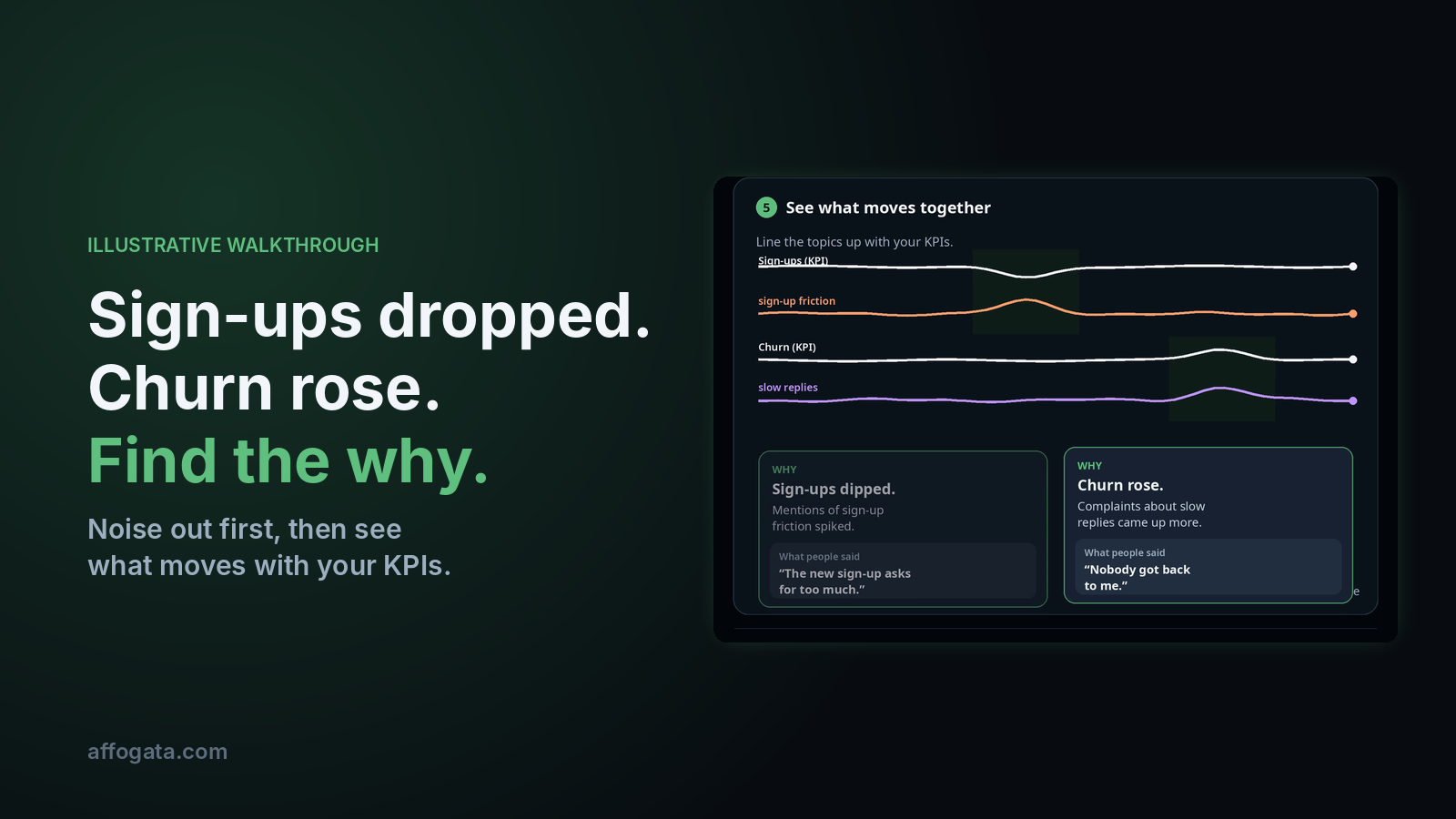
Then we correlate the real signal with your KPIs. When registrations, deposits or retention move, you see the theme that moved with them and the posts behind it. Your team decides what it means. Here’s that step in a one-minute walkthrough.
Does every industry get the same noise?
The seven kinds show up everywhere, but the mix is different:
- Gaming: giveaways, resellers and a copy-paste wave at every launch.
- Fintech and trading: referral codes and pump posts around a ticker.
- Consumer apps, content and streaming: incentivized praise, creator promo and engagement bait.
- Commerce: resellers, coupon farms and affiliate roundups.
- Public affairs, hedge funds and alternative data: coordinated pushes and bots that look like a shift in opinion or in retail interest.
We started in gaming because players are the toughest crowd online. It was the best place to learn what noise looks like. Here’s what it looks like across seven industries.
Why should you trust what’s left?
Because you can check it. Every insight keeps the real posts behind it, so nobody has to take a number on faith.
And because of how it runs: ISO 27001, ISO 27701 and ISO 42001 certified, Microsoft SSPA approved, GDPR and CCPA compliant, read-only, and your data is never used to train AI. For the rest of what security and data teams ask, see the seven questions enterprise teams ask before trusting customer feedback data.
If you take one thing from this post: before a number goes into a report, ask which of these seven made it.
FAQ
What is noise in customer feedback data?
Any piece of content that isn’t a real customer speaking for themselves: ads, campaigns and influencer posts, bots, duplicates and copy-paste waves, giveaways and promo codes, coordinated pushes and AI-generated filler.
Why not just remove spam with keyword filters?
Noise changes faster than keyword lists, and simple rules also remove real users. Reliable filtering combines signals: account behavior, timing, text similarity, conversation context, and whether a theme holds across authors, sources and time.
Can an AI assistant just summarize the raw posts?
It can, but it will summarize what was posted most, which is often what was paid for or automated. Filter first, then summarize, and keep the source posts so the summary can be checked.
Does Affogata work outside gaming?
Yes. Gaming is where we started. Affogata is the Unstructured Data Enablement Layer and works on unstructured data in fintech, consumer apps, content and streaming, commerce, public affairs and alternative data. Try it on the free MCP sandbox.
See what’s left when the noise is gone
Open the live Insights Model to see real events with the posts that prove them. When you want the same on your own data and KPIs, we’ll show you how it works.
Want more?
We are always happy to meet with you and your team. Set a meeting with the Affogata founders, Sharel and Itamar: