Published October 27, 2026
Every team I work with has had this morning. Someone opens the dashboard, sees mentions up 3x overnight and the team channel lights up. Is it a bug? A launch that went viral? A crisis?
Very often it’s none of those. It’s one message, copied a few thousand times.
Duplicates are one of the seven kinds of noise that should never reach your report. They get their own post because they don’t just add volume. They make spikes, and spikes are what people react to.
At a glance
What is a copy-paste wave?
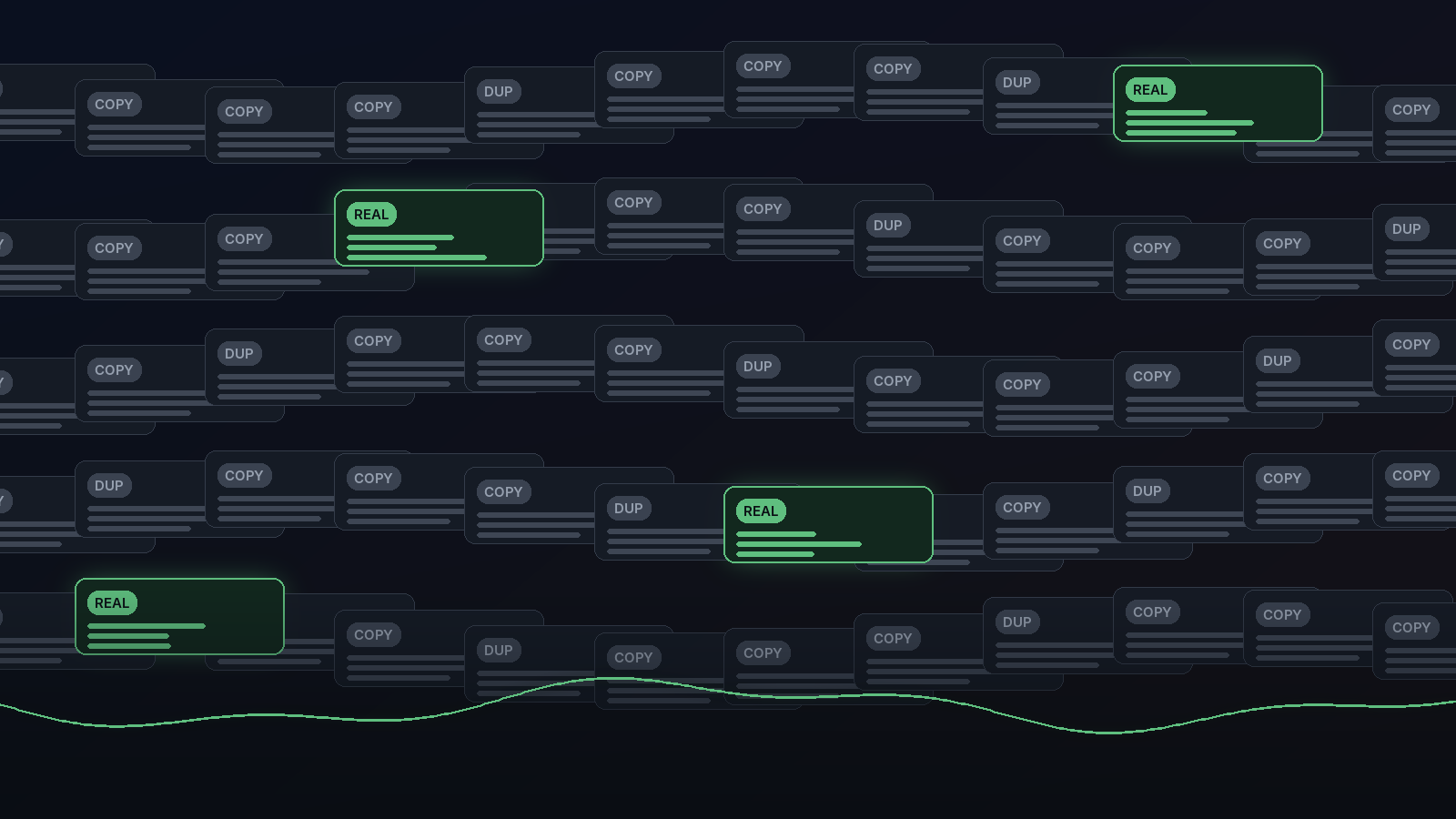
A copy-paste wave is the same message, or almost the same message, posted many times in a short window. One source, many copies. It looks like a crowd, but it’s one voice with a megaphone.
Some waves are exact copies. Many are near-copies: a different handle tagged, an emoji added, a word swapped. To a counter, each one is a new post. To a person reading them side by side, it’s obviously one thing.
Where do duplicates come from?
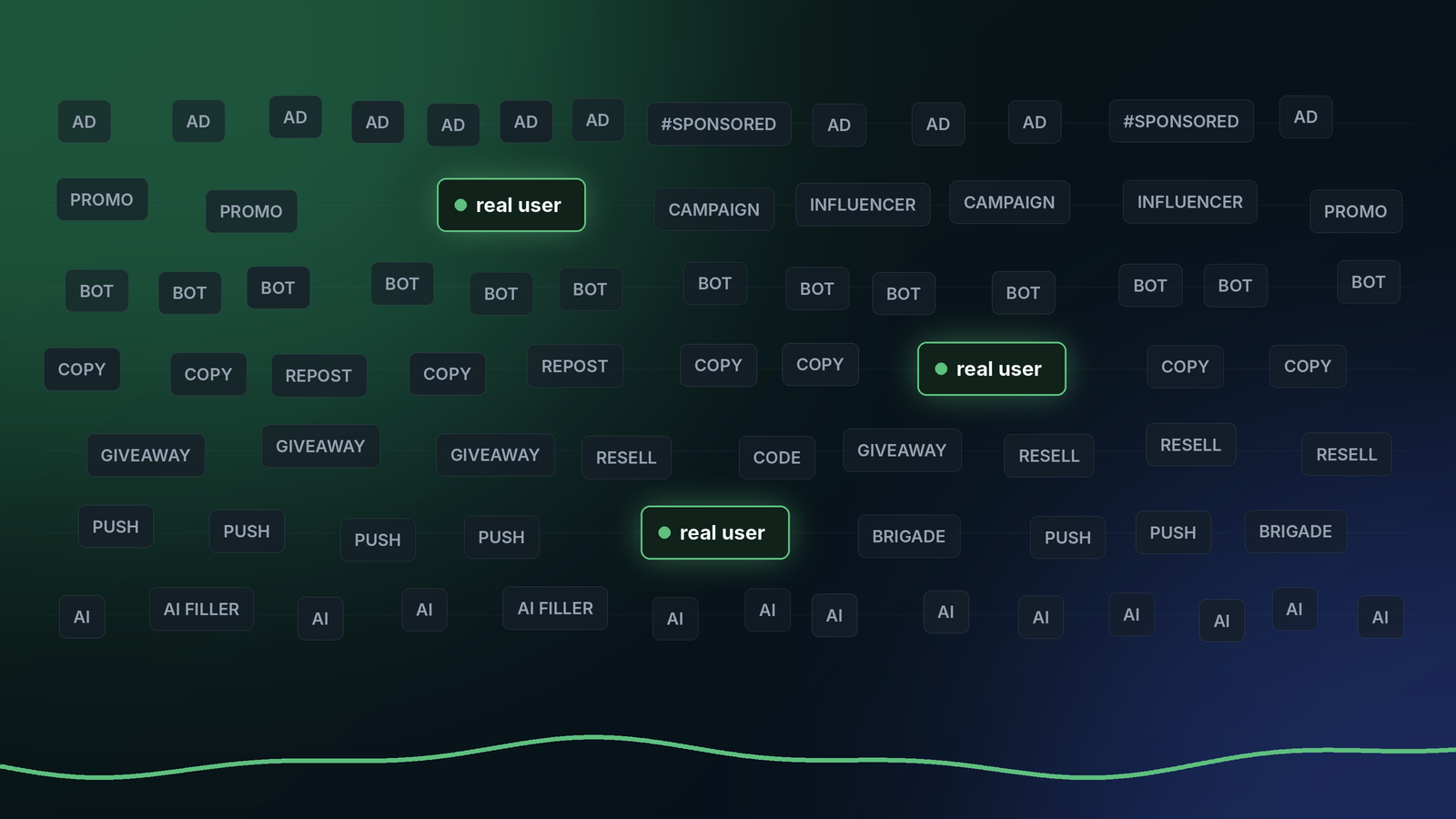
Mostly from things that have nothing to do with how customers feel about your product. The usual sources:
- Giveaways and contests. “Repost and tag three friends to win.” Thousands of entries, one sentence.
- Campaign and creator scripts. The same talking points handed to many accounts, posted within hours.
- Resellers and promo codes. The same offer, the same code, posted again and again.
- Bots and reposting accounts. Automated copies of whatever is trending.
- Coordinated pushes. A group pasting the same complaint or the same praise to move a number.
- Syndicated news. One article, republished across many sites with the same headline.
Contests and campaigns are normal marketing. They just aren’t customers telling you something new.
Why is a spike not always a story?
Because volume counts posts, not people, and a copy wave can make posts jump while the number of real customers stays flat. Here is an illustrative two weeks for one product.
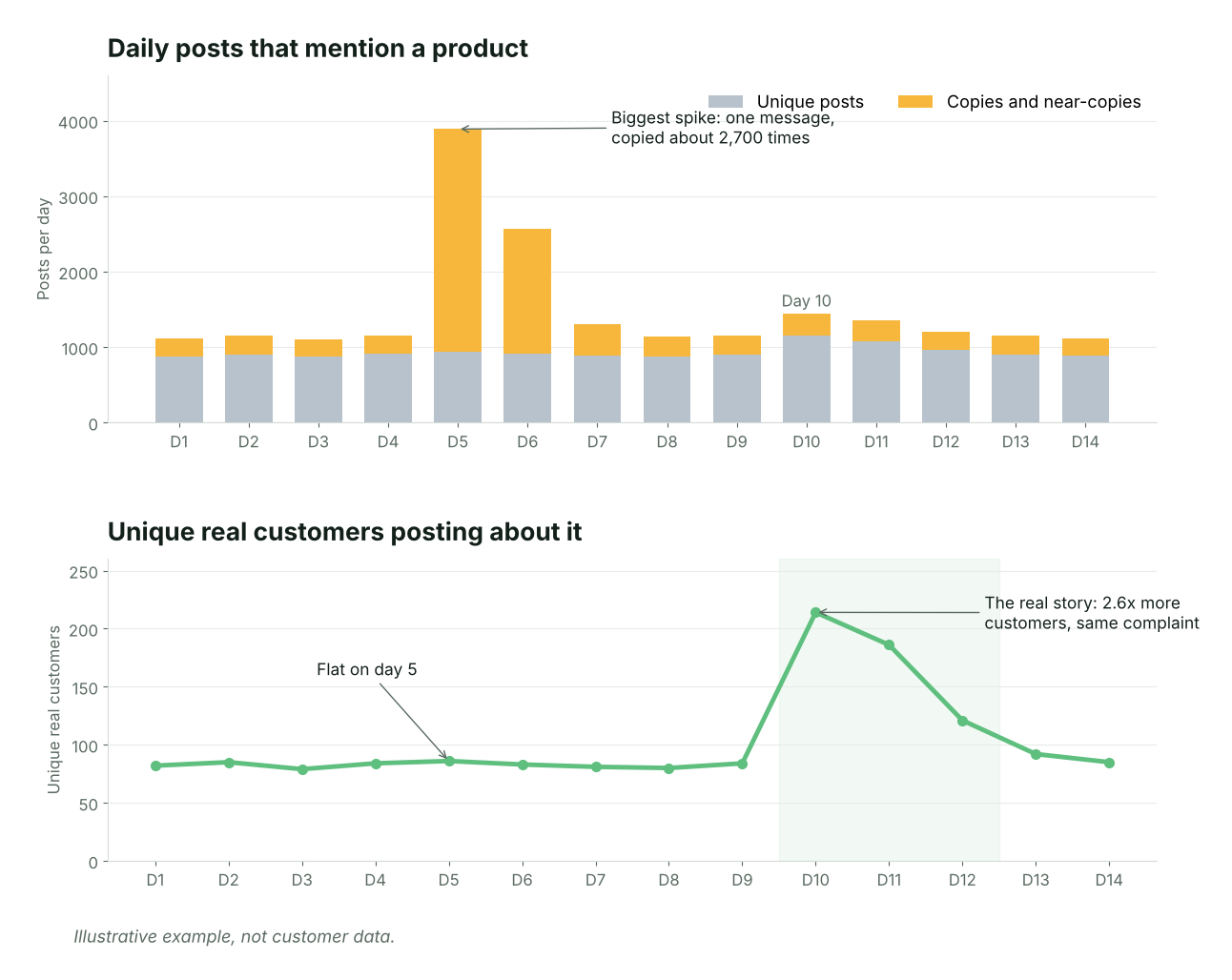
Day 5 is the biggest day of the two weeks, about 3,900 posts against a normal 1,150. Almost all of the jump is one giveaway message, copied about 2,700 times. The number of real customers that day? Flat.
Day 10 barely registers on the top chart. Total posts go up about 25%, the kind of bump nobody opens a ticket for. But the number of real customers posting jumps 2.6x, and most of them describe the same problem in their own words. That’s the day something changed in the product.
The loudest day was a contest. The quiet day was the story.
If your team only watches raw volume, it spends day 5 chasing a giveaway and misses day 10. And if day 10 lines up with a drop in a KPI, that’s the why you were looking for.
Is repetition ever the signal?
Yes, when many different real people say the same thing. The test is not “is this text repeated”. It’s “how many real people are behind it”.
When a payment flow breaks, hundreds of customers paste the same error message. When a community is upset about a change, people post one shared template from their own accounts, often adding a line of their own. Those look like duplicates, but each one is a real person choosing to speak.
So deleting duplicates blindly is as dangerous as counting them blindly. One voice copied a thousand times is noise. A thousand voices saying the same thing is the strongest signal you’ll get.
How do you check a spike before you react?
Count people, not posts, and see whether the posts carry real experience. Five quick checks:
- 1. Posts per author. If posts jumped 3x and unique authors didn’t move, it’s a wave, not a crowd.
- 2. Copy share. What share of the spike is the same text or the same meaning? Above half, look for the origin.
- 3. The first post. Find the earliest version. A brand account, a contest, a creator or a reseller tells you what you’re looking at.
- 4. Timing. Copies land in tight bursts, minutes apart. Real reactions follow the product: a release, an outage, a price change, and they spread over hours and days.
- 5. Detail. Real customers add something: a screen, a step, a version, an amount. Copies carry the same words and nothing else.
You can do this by hand for one spike, not every day across every product, market and language.
How does Affogata handle duplicates?
We collapse copies into one story with a count, keep real repeated voices as signal, and only then measure. In order:
- Noise out first. Ads, campaigns, bots, giveaways, resellers, copies and AI filler come out using many signals together: account behavior, timing, text and meaning similarity, and conversation context. Often only 5 to 10% of the data is real signal.
- Copies become one, with the receipt. A wave is kept as a single item with its size and its origin, so you can still see that it happened without it drowning your charts.
- People are counted once. The real fraction is grouped into themes and events by meaning, in any language, across social, review, support and community data from 40+ public and connected sources, plus your own data.
- Then the KPI. Themes are correlated with the numbers in your own warehouse, so you see which one moved with the metric, and the posts behind it.
You get it where you already work: in the Affogata app, in your data warehouse, inside your AI assistant through MCP, or through an API. It’s the same whether you run a game, a trading app, a subscription product, a streaming service, a store or a public campaign. Copy waves look the same everywhere.
Why does this matter more with AI?
Because an AI assistant reading raw data will treat a copy wave as a huge trend. Ask it what customers talked about this week and it will tell you, confidently, about the giveaway.
Give it the real fraction and it gives you answers you can act on. That’s why we deliver insights, not dumps. Affogata is ISO 27001, ISO 27701 and ISO 42001 certified, Microsoft SSPA approved, GDPR and CCPA compliant, read-only, and your data is never used to train AI. It already runs on some of the largest player and customer communities in the world.
One habit to take from this post: next time a chart jumps, before anyone opens a war room, ask one question. How many people is that?
FAQ
What is a copy-paste wave in customer feedback?
The same message, or a slightly edited version of it, posted many times in a short window, usually from a giveaway, a campaign script, a reseller, bots or a coordinated push. It inflates volume and creates spikes without adding new customer voices.
Should duplicate posts be removed from analysis?
Copies from one source should be collapsed into one item with a count, not deleted, so you still see the wave. But when many different real customers post the same text, like an error message or a shared complaint, that repetition is signal and should be counted by people.
How can I tell if a spike in mentions is real?
Compare posts with unique authors, check what share of the spike is the same text or meaning, find the first post, look at the timing and look for real detail. A spike with flat unique authors and tight bursts of identical text is a copy wave.
How do duplicates affect KPI correlation?
They add spikes that have nothing to do with the product, which weakens any correlation with business metrics and can hide the real change. Counting unique real customers by theme gives a cleaner series to correlate with KPIs. Try it on the free MCP sandbox.
See the real fraction on real events
Open the live Insights Model to see events with the posts that prove them. When you want the same on your own data and KPIs, we’ll show you how it works.
Want more?
We are always happy to meet with you and your team. Set a meeting with the Affogata founders, Sharel and Itamar: