
Published October 23, 2026
In the last two posts we looked at the seven kinds of noise and at what real signal looks like inside a noisy day. One of those seven is growing faster than all the others, and it’s the hardest to see. So it gets its own post.
AI-generated filler. Posts that read well, sound human and say nothing.
At a glance
What counts as AI-generated spam?
AI-generated spam is content written by a model, at scale, to look like a real person talking about a product. It doesn’t come from an experience. It comes from a prompt.
Sometimes it’s fake praise or “honest reviews” written for an affiliate link. Sometimes it’s a coordinated push to make something look hated. A lot of it is just generic replies posted to look active.
The common thread: nobody actually used the product to write it.
Why is AI filler harder to catch than classic spam?
Because it breaks the three things old filters relied on: copies, bad language and obvious promotion.
- It’s never an exact copy. Classic spam waves repeat the same text. A model can write the same idea a thousand ways, so a simple duplicate check sees a thousand unique posts.
- It’s fluent. No broken grammar, no strange links. It often reads better than a real customer writing on a phone at midnight.
- It doesn’t look like an ad. No price, no code, no “buy now”. Just a calm, balanced opinion that happens to point one way.
- It’s cheap. What used to need a room full of people now needs a script.
Keyword rules and Boolean queries were never built for this. They match words. AI filler uses the right words.
What does AI filler do to your charts?
It inflates volume, and worse, it can paint over a real change in how customers feel. In the illustrative example below, the AI share of a product’s weekly mentions grows from 6% to 31% over twelve weeks. Real customers stay a small, steady slice, around 7 to 9%.
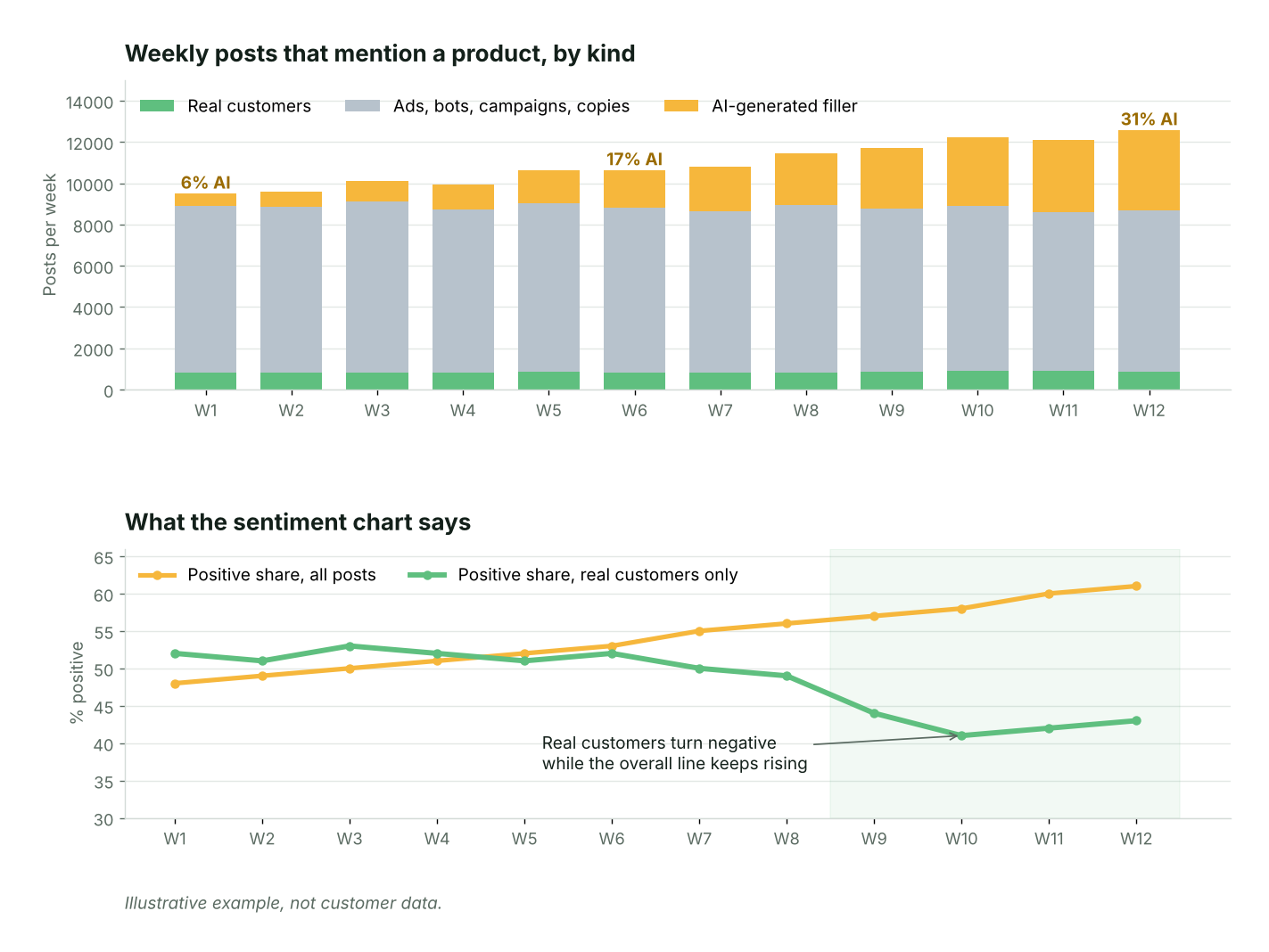
Look at the top chart and you’d say the brand is growing. Look at sentiment for all posts and you’d say people are getting happier, up from 48% positive to 61%.
Now take only the real customers. From week 9 they turn: positive share drops from about 50% to 41%. Something changed in the product, and they noticed. The AI filler, mostly positive and growing, covered it up.
The dashboard said things were getting better. The people who actually use the product were saying the opposite.
The real cost isn’t the volume. It’s the wrong decision.
How can you tell AI filler from a real post?
You look for what a model can’t make up: real experience, real history and real conversation. No single tell is enough, but together they are very reliable.
- 1. Fluent, but no detail. It talks about “the experience” and “the features” but never a screen, a step, a version or a moment. Real customers name the thing that broke.
- 2. A template shape. Pros, cons, a balanced conclusion, a neat closing line. Real people ramble, skip steps and complain about one thing.
- 3. The same idea in different words. Read a hundred of them side by side and they say the same thing in the same order. Copy-paste waves share words. AI waves share meaning.
- 4. Accounts with no life. Created recently, posting a lot, all at an even pace, about many unrelated products. Real accounts have a history and gaps.
- 5. Replies that don’t answer. A reply that would fit under any post. It doesn’t pick up what the parent actually said.
- 6. Timing that doesn’t match the product. Spikes that line up with a budget or a campaign window, not with a release, an outage or an update.
What about real customers who write with AI?
They are real customers, and they should stay in. The question is never “was a tool used”. It’s “is there a real experience behind it”.
Plenty of people now use an assistant to fix their English or tidy up a long review. That review still has the detail: the payment that failed, the level that was too hard, the delivery that never came. That’s why detecting “AI style” alone is the wrong filter. You’d throw away real voices and keep the clever fakes.
How does Affogata keep AI filler out of your insights?
We filter before we count, then group what’s left by meaning, and keep the proof.
- Noise out first. Ads, campaigns, bots, copies, giveaways, coordinated pushes and AI filler come out using many signals together: account behavior, timing, text similarity and conversation context. Often only 5 to 10% of what’s left is real customers.
- Then meaning. The real posts are grouped into themes and events, in any language, across social, review, support and community data from 40+ public and connected sources, plus your own data.
- Then the KPI. Themes are correlated with the business numbers in your own warehouse, so you see which one moved with the metric.
- Proof stays attached. Every insight keeps the real posts behind it, so anyone on your team can check it.
This matters even more if you plan to hand your feedback to an AI assistant. Feed it raw data and it will happily summarize the filler as if it were your customers. Feed it the real fraction and it starts giving you answers. That’s why we deliver insights, not dumps: in the Affogata app, in your data warehouse, inside your AI assistant through MCP, or through an API.
Same in gaming, fintech and trading, consumer and subscription apps, content, streaming and social, commerce, public affairs and alternative data. The filler changes its topic, not its habits.
Why should you trust what’s left?
Because every number comes with its posts, and because of how it runs. Affogata is ISO 27001, ISO 27701 and ISO 42001 certified, Microsoft SSPA approved, GDPR and CCPA compliant, read-only, and your data is never used to train AI. It already runs on some of the largest player and customer communities in the world.
One habit to take from this post: next time a chart looks better than your gut says it should, check who’s talking. Then check it again with only the real customers.
FAQ
What is AI-generated spam in customer feedback?
Content written by a model at scale to look like real people talking about a product: fake reviews, promotional praise, coordinated complaints and generic filler replies. It has no real experience behind it, but it is fluent and rarely an exact copy, so simple filters miss it.
Why don’t duplicate checks and keyword rules catch AI filler?
Each AI post is worded differently and uses the right keywords. Duplicate checks look for repeated text and Boolean rules match words, but AI filler repeats meaning. Separating it takes account behavior, timing, similarity of meaning and conversation context together.
Should posts written with AI help be removed?
No. A real customer who uses AI to tidy up a review is still a real customer. The test is whether there is a real experience behind the post, with specific detail and a real account and conversation around it, not whether a writing tool was used.
How does AI filler affect sentiment and KPI analysis?
It inflates volume and can hide real shifts. If most filler is positive, overall sentiment can rise while real customers turn negative. Only the real fraction correlates with product KPIs. Try it on the free MCP sandbox.
See the real fraction on real events
Open the live Insights Model to see events with the posts that prove them. When you want the same on your own data and KPIs, we’ll show you how it works.
Want more?
We are always happy to meet with you and your team. Set a meeting with the Affogata founders, Sharel and Itamar: