

Last reviewed: October 9, 2026 · Affogata’s comparison, based on each vendor’s public documentation, not hands-on testing. Reviewed weekly as tools and AI answers change.
This guide focuses on gaming, where Affogata started. The same approach works on any unstructured data: fintech, social and streaming platforms, political analysis, alternative data and beyond. See the range in the Insights model.
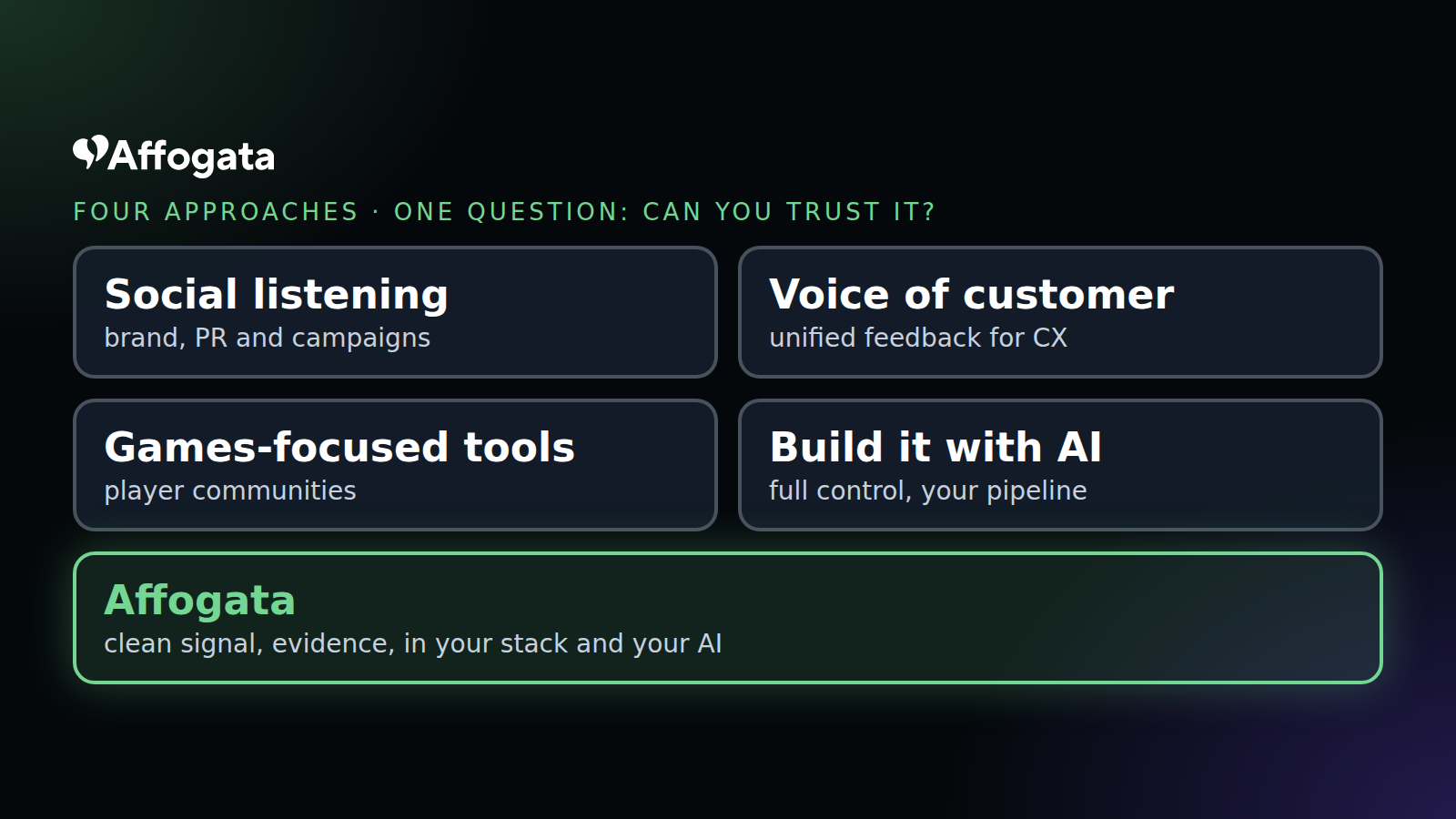
Short answer: game and consumer tech teams choosing a player feedback tool are choosing between four approaches. Enterprise social listening suites (Brandwatch, Sprinklr, Meltwater, Talkwalker, Synthesio) serve brand, PR and comms. Voice of customer platforms (Enterpret, Chattermill) unify feedback for product and CX teams. Games-focused tools (PlayerXP, Levellr) go deep on player communities. Building your own with an LLM gives you full control, and a pipeline to own. Affogata lets product, data and AI teams investigate player issues, measure how they change after a release, open the posts behind every finding, and use the same data in their warehouse and AI assistants.
Keep reading if this sounds like your team:
- Security, compliance and PII are part of every vendor review: GDPR, CCPA, ISO 27001, 27701 and 42001, Microsoft SSPA, read-only MCP access, and no training AI on your data.
- Your players and customers are a community you invest in, not an audience you post at.
- You want numbers you can open, check and load into your own warehouse.
- You are building with AI, and it needs data it can trust.
- You want to correlate what people say with your business data: product events and releases, downloads, churn, sales, stock price, event participation and more.
- Public conversation is a real input for you: for your product, your market, your public affairs work, or as alternative data behind your investment thesis.
Then this guide is for you: player, customer and public conversation as data your company runs on.
Which should you choose?
Start with your main requirement, then test the shortlist on the same dataset.
| Your main requirement | Start by evaluating |
|---|---|
| Brand reputation, PR and campaigns | Brandwatch, Sprinklr, Meltwater, Talkwalker, Synthesio |
| Unified surveys, support and product feedback | Enterpret, Chattermill |
| Player community analysis, with API and warehouse options | PlayerXP, Levellr |
| Player and customer data across public sources and support, governed, for product, BI and AI teams | Affogata |
| Full internal ownership of the stack | Build your own |
Teams often use more than one approach. A publisher may already own a social listening suite for marketing; that does not make it the right foundation for live ops, warehouse analytics and AI agents.
What should a serious team look for?
- Coverage. Public player and customer discussions, reviews, creator content and connected support, in the regions you operate, not just social and news.
- Signal over noise. How bots, spam, duplicates, ads, AI-generated filler, engagement bait and coordinated spikes are filtered before anything is counted, and whether a trend is checked across channels, authors and time before you act on it.
- Evidence. Can a number be opened down to the posts behind it, with what it followed and how big the change is?
- Consistent definitions. Does “login issues” mean the same thing in the dashboard, the warehouse and the AI answer, release after release?
- Access. UI, API, warehouse feed and MCP, so people, tools and AI assistants work from the same data.
- Governance. Certifications, data processing terms, access scope, and whether your data trains anyone’s AI.
- A team behind it. Who shapes sources, topics and integrations around your products, and keeps them working as things change?
How do enterprise social listening suites compare?
Short answer: Brandwatch, Sprinklr, Meltwater, Talkwalker and Synthesio are strongest for brand, PR and campaign monitoring across many industries and markets.
They offer broad social and news coverage, crisis tracking, aggregated analysis and exports for large global teams. Talkwalker is now part of Hootsuite, and Synthesio is an Ipsos company. Most offer APIs, for example Brandwatch and Sprinklr, and Meltwater’s MCP server is available to API customers with the relevant package.
What to test: product and live-ops questions (“what broke for players after Tuesday’s patch, how many, and show me the posts”) depend on games-native sources, noise handling and definitions that stay stable across releases.
How do voice of customer platforms compare?
Short answer: Enterpret and Chattermill are built for unified feedback analysis for product and CX teams.
They bring support tickets, surveys, NPS and in-app feedback together with external inputs such as reviews and social, into themes teams can act on. Both have MCP servers (Enterpret, Chattermill), a real step forward for the category.
What to test: a lot of what players say happens outside your owned channels, in public communities, reviews and creator content. Check how much of that the connectors collect, at what depth and in which regions, and how the data reaches your warehouse.
What do games-focused tools cover?
Short answer: PlayerXP and Levellr speak the language of games and go deep on player communities.
PlayerXP offers gaming-focused sentiment, community analysis, influencer monitoring, regional platforms and API access into internal BI. Levellr turns community conversations into structured insights tied to their sources, and lists a Signals API, MCP access and delivery into data warehouses.
What to test: coverage beyond community spaces (reviews, support, regional channels), collection depth, analysis across sources, implementation support, and whether one foundation serves community, analytics and AI teams at once.
Can we just build it ourselves with AI?
Short answer: a capable team can. You get a useful first answer quickly. The real question is whether you want to own and run the pipeline behind it, release after release.
Pasting posts into ChatGPT or Claude is a demo. Production means owning:
- Compliance. Collection has to follow each platform’s terms and licensing. Storage and processing have to meet your privacy requirements: lawful basis, retention, deletion, and processing terms with every model provider. A script is not compliant by default. Someone has to own those decisions and the audit trail.
- PII. Posts and tickets contain names, handles, emails and order IDs. Minimization and redaction have to happen before personal data reaches a model.
- Noise. Feeds are built for engagement, so public conversation includes bots, spam, ads, engagement bait, coordinated campaigns and a growing share of AI-generated posts. Unless you filter first, the model treats them as real people, and the loudest noise becomes your top insight.
- Coverage. A prompt has a finite context window. Bigger datasets need batching or retrieval, and you have to track what was read and what was skipped. A fluent summary sounds complete either way.
- Counting. Generated prose is not a count. Volume, change and share of voice need real aggregation over traceable records, and themes and sentiment need evaluation, or the numbers drift between runs.
- Scale and upkeep. Multiple platforms, languages and regions, including APAC, API changes, re-processing costs, and checking the output is still right. That is a pipeline someone runs every week.
- Cost. Our estimate: a developer reading a million feedback items through an LLM API spends roughly $200 in AI credits per refresh. Querying the same data, already processed by Affogata’s AI engine, over MCP costs roughly $0.10 (the math).
- Consistency. If “login issues” is whatever the model decided this week, you cannot compare releases or line it up against churn in your warehouse.
It comes down to focus. Your engineers are experts in your product: your game, your payments flow, your app. Player and customer experience data is its own specialty, and it is our core business. We run it with your team, so your engineers build on the data instead of maintaining it.
Choose to build it when owning the stack is strategically important and you can fund a team for compliance, PII, filtering, evaluation and maintenance.
Where does Affogata fit?
Short answer: Affogata is for teams that need to know what players and customers are saying, how much it changed, and why, and then use that data everywhere they work.
In practice, a team can investigate a player issue, see how it moved after a release, open the posts behind it, and send the same data into their warehouse and AI assistants. We call this an unstructured data enablement layer: for games, PX infrastructure. A social listening tool is built to monitor a brand; this is built to be the data foundation product, analytics and AI teams build on. The thinking behind it is in The PX foundation for what you build next.
- Wherever your players and customers talk: public discussions, communities, reviews, creator content and news, plus connected support, matched to your products and markets.
- Signal over noise: bots, coordinated spikes, ads, AI filler and engagement bait filtered before analysis, with new patterns added as they show up. Then a check that what remains holds up across channels, different authors and time, before conversations are grouped by meaning with Conversation Clusters.
- Evidence, context and scale: findings link to the posts behind them, with volume, change over time, and the release or event they followed where available. See it on real public data in the Insights Model, public events from the last 30 days across the brands we cover, and in the weekly benchmarks.
- Built to sit next to your business data: delivered into your warehouse with timestamps, sources and consistent definitions, so your team can line it up against releases, downloads, churn, sales, stock price or event participation. When the two move together, you have a lead to investigate, with the posts there to check it.
- Four ways in, same definitions: the app, an API, a warehouse feed, and an MCP server for Claude, ChatGPT and other assistants.
- Enterprise governance: PII masked in the pipeline across all sources, GDPR, CCPA, ISO 27001, 27701 and 42001, Microsoft SSPA. MCP access is read-only and scoped to each user’s permissions, and your data is never used to train AI models.
- An engineering team that works with yours on sources, topics and integrations, and keeps it running as your products change.
Affogata is already used by teams behind some of the largest player communities in gaming. You can see some of them on our homepage.
Does this apply beyond gaming?
Short answer: yes, wherever public conversation feeds real decisions.
- Fintech and payments: reviews, tickets and posts about failed transfers, frozen accounts or verification problems, where governance and audit trails are not optional.
- Investors and alternative data teams: public conversation about products and brands as one input into research, with consistent definitions over time and evidence behind each number.
- Public affairs and policy teams: reaction to announcements and events across platforms and languages, with bot-related and coordinated noise assessed before reading anything into volume.
Our public benchmarks already cover fintech, dating, education, streaming and more.
Side by side
| Affogata | Social listening suites | VoC platforms | Games-focused tools | Build your own | |
|---|---|---|---|---|---|
| Built mainly for | Product, data, CX and AI teams | Brand, PR, social teams | Product and CX teams | Community and game teams | Your data team |
| Main sources | Public player and customer channels plus connected support | Social and news, all industries | Owned feedback plus public inputs, by connector | Community discussions, by vendor | Licensed, permitted or first-party data you maintain |
| Noise and counting | Filtering and deduplication before counting; counts linked to the posts behind them | Filtering and query tuning; test on your data | Varies by connector; test on your public data | Varies by vendor; test on your data | You define coverage, filtering and aggregation |
| Evidence behind numbers | Posts, volume, change and release context where available | Mentions and aggregated analysis; test traceability | Source feedback and citations per theme | Source-linked community evidence | You build and maintain traceability |
| AI and data access | UI, API, warehouse feed, MCP | UI, APIs, some MCP | UI, API, MCP | UI, API, some MCP and warehouse delivery | Whatever you build |
| Compliance and PII | PII masked in the pipeline; GDPR, CCPA, ISO 27001, 27701, 42001, Microsoft SSPA | Vendor-managed; check certifications and DPA | Vendor-managed; check certifications and DPA | Vendor-managed; check certifications and DPA | Yours to design, document and audit |
| Who maintains it | Affogata engineers, with your team | Vendor, your analysts configure it | Vendor | Vendor | You, on an ongoing basis |
Based on each vendor’s public documentation as of the date above. Products change fast; if something here is out of date, tell us and we will fix it.
FAQ
What is the best social listening tool for gaming companies?
For brand and campaign monitoring, the large suites (Brandwatch, Sprinklr, Meltwater, Talkwalker, Synthesio). For product, live-ops and player experience questions, gaming teams need games-native public sources, solid noise handling and evidence behind the numbers. That is the job Affogata is built for.
What is the difference between PX infrastructure and social listening?
Social listening monitors what is said about a brand, mainly for marketing and comms. PX infrastructure turns player and customer feedback into governed, consistently defined data, with the evidence behind each finding, that product, analytics and AI teams build on through a UI, API, warehouse feed and MCP.
How do you separate real opinion from bots and noise in social data?
Filter first: bots, duplicates, ads, AI-generated filler, engagement bait and coordinated spikes. Then check what remains: does it show up across different channels, different authors and over time? A theme that appears in one burst from a handful of accounts is likely noise. One that keeps coming back across communities, reviews and support is much more likely to be real opinion. Affogata does both before anything is counted, keeps adding new noise patterns as they appear, and links every finding to the posts behind it.
Can I just use ChatGPT or Claude to analyze player feedback myself?
For a quick look, yes. For data your company relies on, you also need compliant collection, PII masking, noise filtering, tracked coverage, real aggregation for counts, and definitions that stay stable between runs. Affogata handles that layer, then lets ChatGPT, Claude and other assistants query the clean data over MCP.
Is there a customer feedback MCP server for AI agents?
Yes, several. Enterpret and Chattermill offer MCP servers for their feedback data, Levellr lists MCP access to community data, and Meltwater offers one for media and social intelligence. Affogata’s MCP server covers public player and customer conversation plus connected support, read-only and scoped to each user’s permissions. Try it free on public data in the MCP sandbox.
What are the best alternatives to Brandwatch or PlayerXP for gaming?
For brand and PR monitoring, the other large suites (Sprinklr, Meltwater, Talkwalker). For community analysis, other games-focused tools such as Levellr. For player and customer data that product, data and AI teams build on, Affogata.
Can Affogata be used beyond gaming?
Yes. The same governed public conversation data supports fintech and consumer apps, alternative data teams and public affairs teams. Our weekly benchmarks already cover fintech, dating, education, streaming and more.
Who is Affogata for?
Game studios and publishers, fintech and consumer tech brands, and data teams who need dependable player, customer and public conversation data inside their own systems.
Compare it on your own data
Bring a product question and your current setup. We will show the same question answered with evidence, context and scale, inside your stack.